US Economic Growth Accelerates as Consumer Spending and AI Investment Strengthen
The United States economy expanded at an annualized rate of 3.4% in the third quarter of 2026. Growth accelerated from 2.2% in the second quarter and exceeded the approximately 3% growth rate expected by economists cited in the Associated Press report.
The advance estimate from the US Bureau of Economic Analysis indicates that economic activity remained resilient despite elevated energy costs and tighter financial conditions. However, the headline growth figure masks meaningful differences between the sectors supporting the expansion and those still facing pressure.
Consumer Spending Supports Growth
Consumer spending was a major contributor to the stronger result, rising at a 3.8% annualized pace. Household consumption matters because it represents a substantial portion of US economic activity.
Continued spending can support business revenue, employment and production, even when consumers face higher fuel prices and borrowing costs. At the same time, a strong aggregate figure does not necessarily mean that every household is financially comfortable.
The economy-wide data must be considered alongside consumer confidence, housing affordability and the cost of servicing debt.
AI Investment Strengthens Business Spending
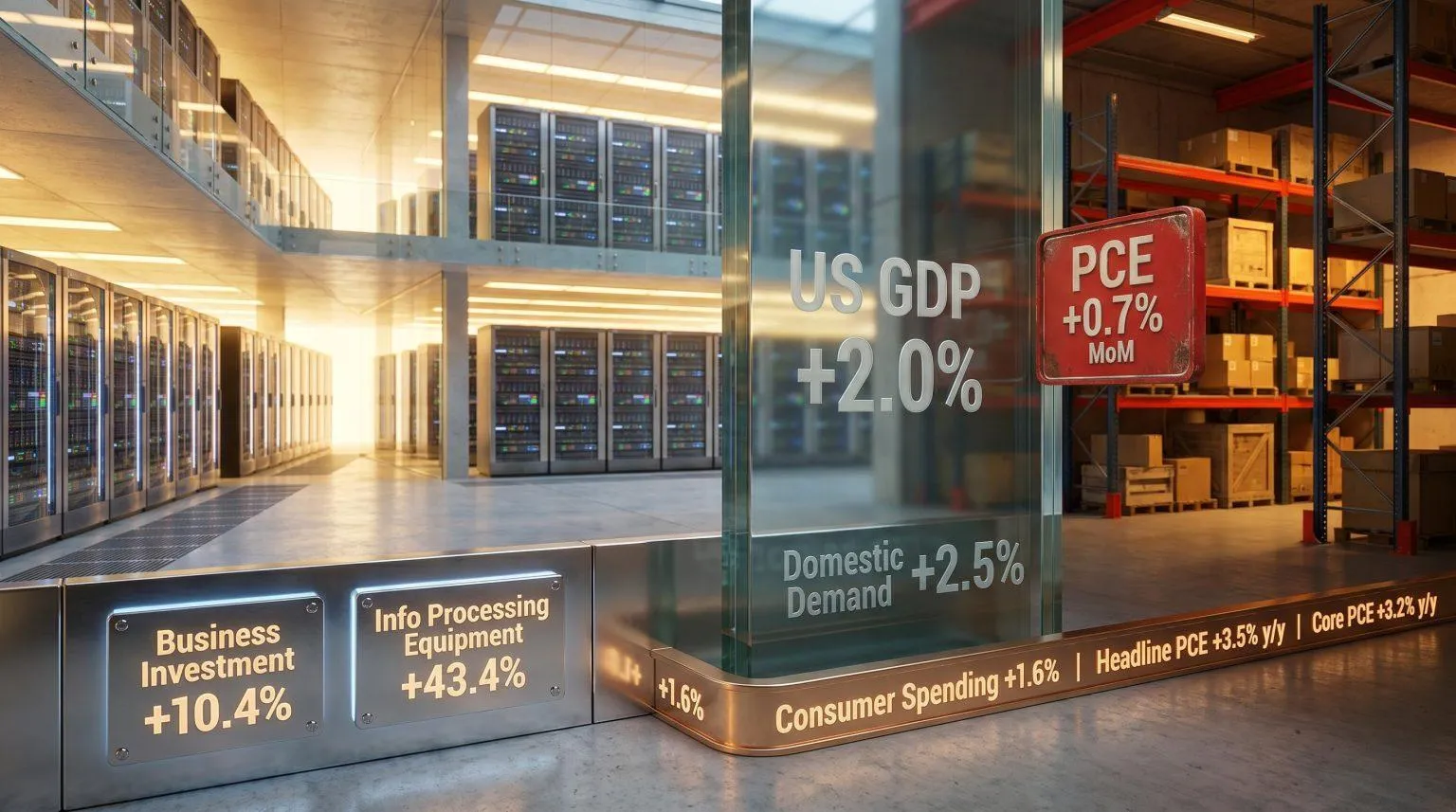
Business investment also provided substantial support, particularly spending connected with artificial intelligence. Investment excluding residential housing rose 12.7%, while spending on information-processing equipment surged 37.4%.
Companies are continuing to commit resources to computing hardware, software and research and development. They are expanding digital infrastructure and AI capabilities.
This investment can increase demand for technology equipment and related services. It can also potentially improve productivity over time. Nevertheless, the immediate increase in spending raises questions about financing costs. It also raises questions about whether future revenue will justify the scale of investment.
Housing Remains a Weak Point
Housing remained a weak point. Residential investment declined 3.3%, extending a pattern of weakness in a sector affected by elevated mortgage rates and affordability constraints.
Housing is sensitive to financing conditions because purchases and construction typically require substantial borrowing. Higher rates can discourage homebuyers, delay development projects and reduce activity across related industries.
This weakness illustrates why robust GDP growth can coexist with pressure in specific parts of the economy.
GDP Estimate Could Still Change
The report also needs interpretation as an advance estimate, rather than a final measurement. The BEA normally revises its GDP calculations as more complete information becomes available.
Future estimates may therefore alter the measured contribution from consumer spending, investment, trade or government activity.
What the Data Could Mean for Financial Markets
For financial markets, the data create a complicated policy backdrop. Stronger growth can support corporate earnings and reduce immediate fears of an economic slowdown.
However, if demand remains firm while inflation is elevated, the Federal Reserve may have less room to ease monetary policy. Interest-rate expectations influence Treasury yields, the US dollar, equity valuations and gold prices.
Technology companies may benefit from robust investment demand. However, high financing costs can also make expensive growth projects more difficult to justify.
The Key Question for Investors
The key question is whether economic momentum remains broad-based or increasingly depends on household consumption and heavy AI-related investment.
Investors will need to assess subsequent inflation, employment, consumption and GDP releases before deciding whether the third-quarter result signals durable strength or a growth mix that carries financial and policy risks.