US Economic Growth Accelerates in the Third Quarter
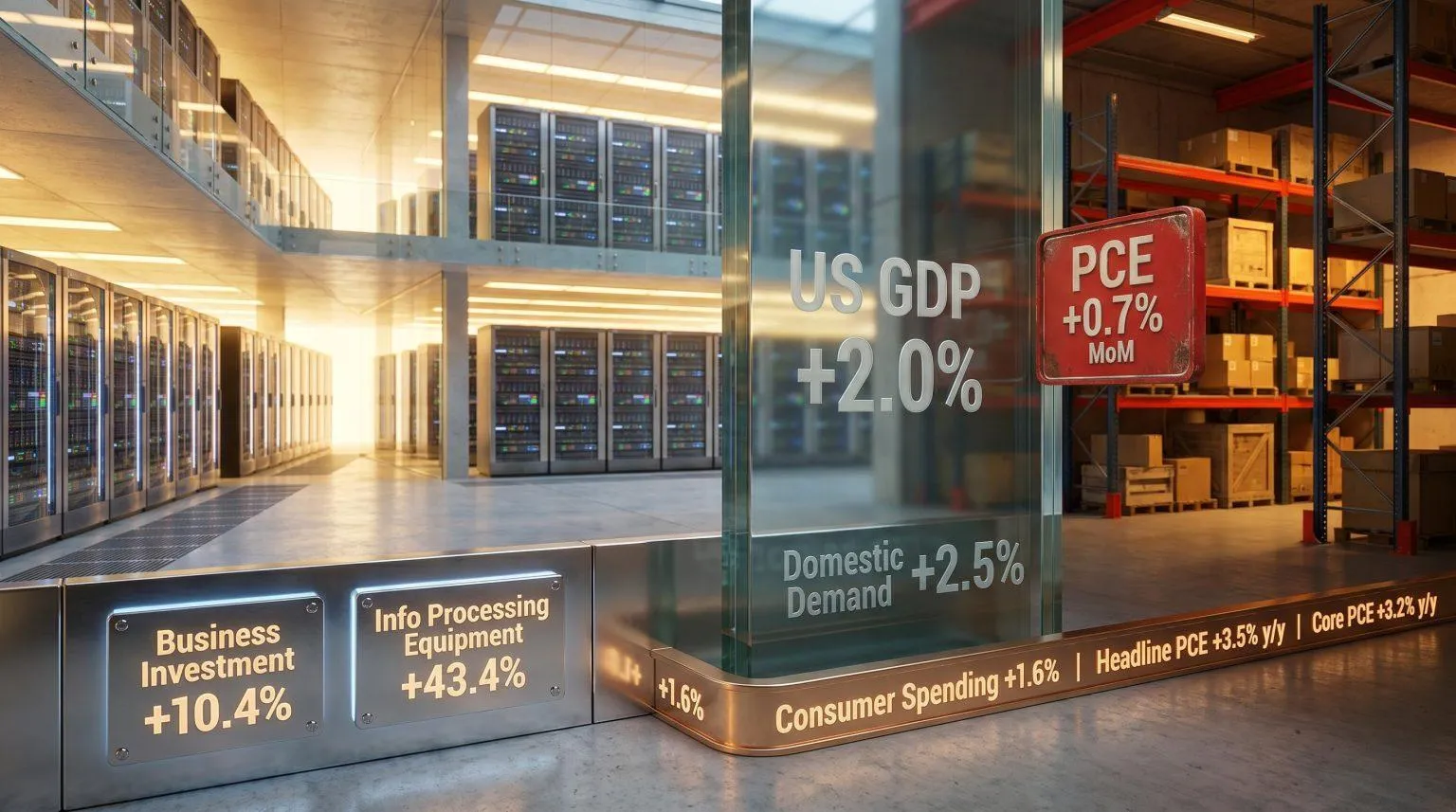
The US economy grew faster in the third quarter of 2026. The advance estimate of gross domestic product showed an annualized growth rate of 3.4%, up from 2.2% in the second quarter. The figure also exceeded the approximately 3% growth forecast reported by the Associated Press.
The US Bureau of Economic Analysis released the estimate on October 29, 2026. The BEA said consumer spending, investment, and government spending contributed to the increase. A decline in exports partly offset growth, while imports increased during the period.
U.S. Bureau of Economic Analysis (BEA)+1
The stronger result suggests that US economic activity remained resilient despite elevated energy costs and relatively restrictive financial conditions. For investors, the report matters because it can influence interest-rate expectations, the dollar, Treasury yields, and valuations across US equity markets.
However, one GDP report cannot establish the direction of the economy over the next several quarters. The figure is an advance estimate and may be revised when more complete data becomes available.
Consumer Spending Remains a Major Growth Driver
Consumer spending rose 3.8% in the third quarter, according to the Associated Press. Household consumption represents a substantial share of US economic activity, so changes in spending can have a meaningful effect on overall growth.
The increase suggests that households continued to spend despite elevated energy prices and expensive borrowing. Resilient consumption can support corporate revenue, labor demand, and broader business activity.
Nevertheless, strong consumption must also be assessed alongside inflation. If demand remains robust while productive capacity is constrained, businesses may have more room to raise prices. If such pressure spreads across the economy, inflation could become more difficult to control.
Investors therefore cannot treat stronger GDP as an unambiguously positive development. They must also consider whether continued growth could affect the Federal Reserve’s monetary policy decisions.
Business Investment and AI Infrastructure
Business investment was another important contributor to growth. The AP reported that nonresidential investment increased 12.7%. Within that category, investment in information-processing equipment surged 37.4%, supported by spending related to technology and AI infrastructure. Software investment and research and development also increased.
AP News
Capital expenditure can improve productivity when it creates more efficient technology and production processes. However, large investments also carry risks if companies fail to generate enough revenue to justify the cost.
The distinction between economic data and stock-market sentiment is important. Strong investment can contribute to GDP growth, but it does not guarantee that every technology company will generate returns sufficient to support its share valuation.
That distinction was visible in US trading on October 29. Reuters reported that the Nasdaq Composite fell 1.37%, the S&P 500 declined 0.30%, and the Dow Jones Industrial Average lost 0.25%. The declines came despite the stronger economic growth report.
Reuters
Investors can therefore view macroeconomic growth positively while selling shares in businesses facing concerns about revenue, margins, or capital expenditure.
Housing Remains a Weak Spot
Not every part of the economy showed improvement. The AP reported that residential investment declined 3.3% in the third quarter. Housing investment has fallen in six of the past seven quarters amid elevated mortgage rates.
Housing is sensitive to borrowing costs. When interest rates remain high, mortgage payments become more expensive and affordability can deteriorate. These conditions can affect construction, property transactions, and related consumer spending.
Weakness in housing is a reminder that aggregate GDP growth can conceal significant differences between industries. Consumer spending and technology investment may be strong while other sectors continue to struggle.
The GDP report is also an advance estimate rather than a final figure. The BEA scheduled its next estimate for November 25, 2026. Revisions could change investors’ assessment of the US economic outlook.