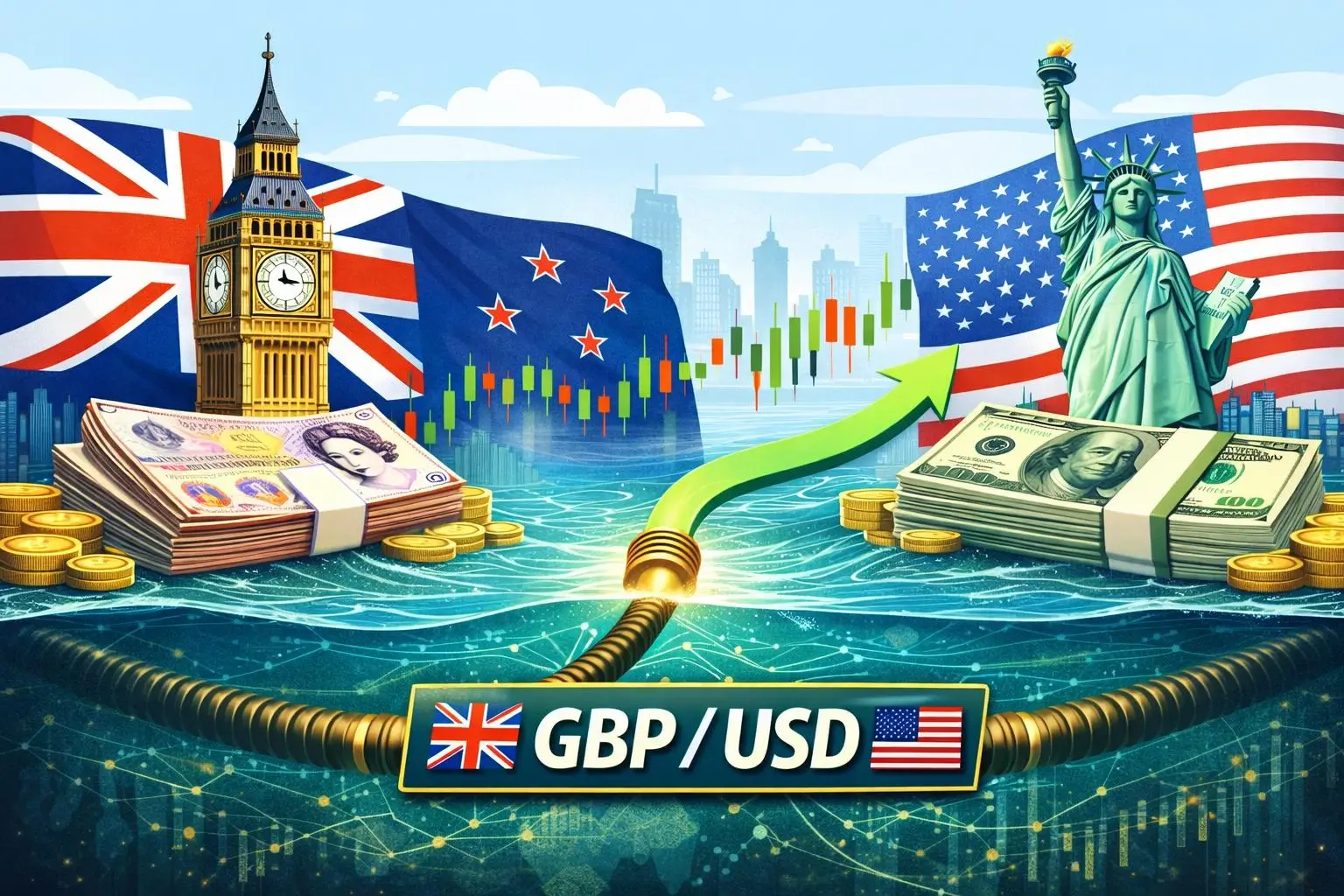
If you follow currency news, you may hear traders say “cable” instead of GBP/USD. The nickname refers to the exchange rate between the British pound and the US dollar.
The most common explanation is that the rate once traveled between London and New York through the transatlantic telegraph cable laid in the nineteenth century. As a result, the name stuck.
So why is GBP/USD called cable? The answer is really a story about how financial information used to travel. At the time, this was long before screens and the internet.
What does GBP/USD actually show?
GBP is the code for the pound sterling, the currency of the United Kingdom. USD is the code for the US dollar.
In simple terms, the pair shows how many US dollars are needed to buy one British pound.
In a quote of GBP/USD, the pound is the base currency. The dollar is the quote currency.
If the pair is at 1.30, one pound costs 1.30 dollars. (That figure is only an example. Therefore, check a reliable source for the current rate.)
When the number rises, the pound is gaining value against the dollar. When it falls, the pound is losing value against the dollar.
The story behind the nickname
In the nineteenth century, people laid a telegraph cable across the Atlantic Ocean. In this way, it connected Britain and North America.
Before the cable existed, news and prices could take days to cross the ocean by ship. With the cable, however, a message could travel almost instantly.
Because London and New York were two of the world’s most important financial centers, the pound-dollar rate became one of the key pieces of information sent along that line.
Over time, traders began referring to the rate as “cable.” The term survived long after the technology behind it changed.
The exact details of the story appear slightly differently across sources. However, nobody can point to a single moment when the nickname was born.
Even so, most accounts agree on the link to the transatlantic telegraph. Today, electronic systems deliver the rate within a fraction of a second. Nevertheless, the old word remains part of market slang.
Why does the pound-dollar rate matter?
The pound has a long history. In fact, people often describe it as one of the oldest currencies still in everyday use.
London remains a major global financial center. In addition, the United Kingdom also has deep trading, banking, and investment ties with the United States.
For ordinary people, the pound-dollar rate can matter in many ways:
- Travel. It affects the cost of a trip to London for someone paying in dollars. Likewise, it affects a trip to New York for someone paying in pounds.
- Business. Companies that buy or sell goods and services between the two countries face exposure to the rate.
- Education. Students paying tuition or living costs abroad notice rate changes in their budgets.
- Investments. Fund managers and companies that hold assets in both currencies track the rate to understand their returns.
What moves GBP/USD?
Like any currency pair, GBP/USD reflects the relative strength of two economies. It also reflects the choices of two central banks.
- The Bank of England and the Federal Reserve. Each sets interest rates for its own currency. Therefore, differences in rates can influence which currency looks more attractive. Statements about future decisions can also affect the pair.
- Inflation and growth. Data on prices, jobs, and economic activity in the United Kingdom and the United States can change expectations.
- Politics and policy. Elections, budgets, and major decisions can shift confidence. The pound moved sharply around the 2016 referendum on leaving the European Union. For example, this event often serves as an example of how politics can influence a currency.
- Global mood. During uncertain times, investors may shift money among currencies and assets. As a result, such moves can affect both sides of the pair.
Overall, no single factor works alone. Their importance also changes from one period to the next.
A simple example
Suppose a UK company sells software to a US customer for 100,000 dollars. The figures below are for illustration only.
- If GBP/USD is 1.25, the company receives about 80,000 pounds.
- If GBP/USD is 1.35, the same payment is worth about 74,100 pounds.
The customer paid the same amount. However, a higher GBP/USD means the pound is stronger. Therefore, each dollar converts into fewer pounds.
This is why exchange rates matter to businesses. This remains true even when prices are agreed in advance.
Common misconceptions
“The name ‘cable’ has something to do with how the pair behaves.”
It does not. The nickname is only a historical label. In other words, it tells you nothing about price movements.
“The telegraph cable still carries the rate.”
Not anymore. Modern markets use electronic networks. Today, the term is simply tradition.
“GBP/USD only reflects the UK economy.”
It reflects both sides. In fact, a move can come from a stronger pound, a weaker dollar, or both.
What readers should understand
- Cable is a nickname for GBP/USD, the British pound to US dollar exchange rate.
- Historically, the name is commonly linked to the transatlantic telegraph cable once used to transmit the rate.
- Meanwhile, the pair reflects central bank policy, economic data, politics, and global mood in two major economies.
- Therefore, the nickname is a piece of market history, not a hint about future direction.
For current rates or details on interest-rate decisions, check an authoritative source such as the Bank of England, the Federal Reserve, or a reputable financial data provider.
Frequently asked questions
Is cable the same as GBP/USD?
Yes. Traders use the word “cable” to refer to the same pair. In other words, both describe the price of one pound in US dollars.
Do other currency pairs have nicknames?
Yes. Market slang includes a number of informal names for pairs. However, some are less widely used than cable.
They are conveniences, not official terms.
Why does the pound sometimes move sharply?
Many things can affect it at once. For example, these include central bank signals, surprising data, and political events.
As a result, large reactions often happen when new information changes what the market expected.